 Dr Antimo Buonocore
 Four Perspectives on Visual Cognition at the Kanizsa Lecture 2026
Visual cognition can be approached from many different perspectives. But what determines how we make sense of the visual world, and how we respond to it?
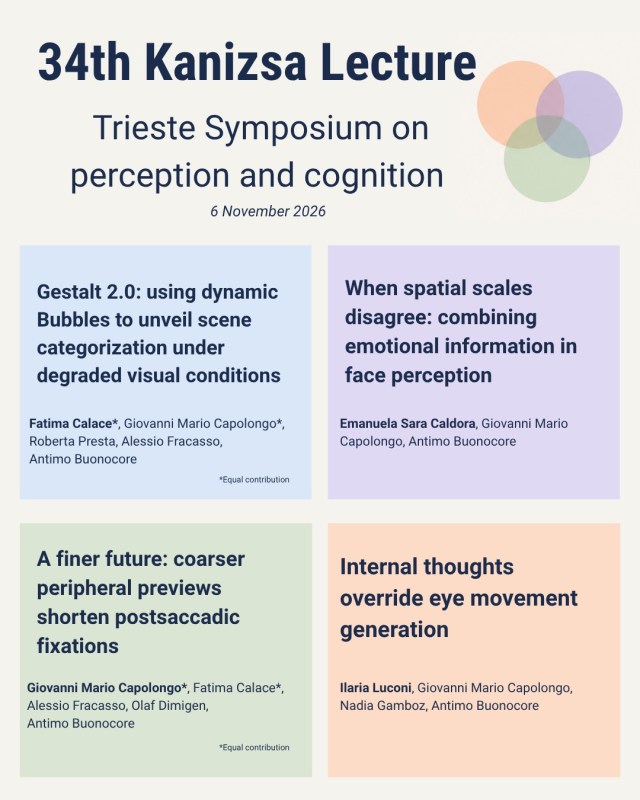
This year, at the 34th Kanizsa Lecture – Trieste Symposium on Perception and Cognition, our lab will present four studies addressing different aspects of this broad question, from the earliest stages of visual information processing to more complex perceptual and attentional mechanisms.
Our journey begins with a fundamental question: how does information acquired in peripheral vision influence what happens when we look directly at an object? Before each eye movement, peripheral vision provides information about what we are about to see. But is a physically identical preview necessarily the most useful one? Giovanni Mario Capolongo investigates this question through trans-saccadic processing, showing that peripheral previews containing lower spatial frequencies than the subsequent foveal target can actually shorten fixation durations. These findings challenge the assumption that physical similarity always provides the greatest benefit across eye movements, suggesting a more complex relationship between peripheral and foveal representations.
From there, we move to the processes through which visual information becomes meaningful percepts. Fatima Calace investigates how we recognize natural and man-made scenes when image quality is degraded and visual information is progressively revealed. Using a dynamic version of the Bubbles technique, the study shows that degradation does more than simply reduce recognition performance: it changes which visual features contribute to perceptual decisions, revealing a flexible use of spatial frequency, sharpness, and colour information.
A related question emerges when different sources of visual information convey conflicting meanings. Emanuela Sara Caldora examines how the visual system combines emotional signals carried by different spatial scales in facial expressions. By presenting hybrid faces in which low and high spatial frequencies convey different emotions, the study reveals that both scales contribute to emotional judgments, although coarse information receives substantially greater weight. Rather than selecting one source and ignoring the other, the visual system appears to integrate conflicting signals in an asymmetrically weighted manner.
Finally, we turn to a broader dimension of visual cognition: what happens when our attention shifts away from the external world and toward our own thoughts? Visual processing is not determined by incoming sensory information alone. Ilaria Luconi investigates how fluctuations in attention and internally generated thoughts relate to our oculomotor responses to unexpected visual events. By combining a sustained-attention task with measurements of saccadic inhibition, pupil dynamics, blinking, and subjective reports of mind wandering, the study explores how changes in attentional engagement accompany changes in visual responsiveness over time.
Together, these four studies illustrate how understanding visual cognition requires considering not only the properties of sensory information, but also how that information is transformed across eye movements, combined into meaningful representations, and processed in the context of our ongoing mental activity.
These contributions also reflect the work of a new generation of researchers in our lab at Suor Orsola Benincasa University, bringing together the research of PhD student Giovanni Mario Capolongo and Master’s students Fatima Calace, Emanuela Sara Caldora, and Ilaria Luconi.
We look forward to presenting these findings and exchanging ideas with the perception and cognition research community in Trieste.
Conference: 34th Kanizsa Lecture – Trieste Symposium on Perception and Cognition, 2026
Our posters and abstracts: Official TSPC 2026 poster programme